
Quick take: Most decisions get stuck because everything stays in your head. Write the options down, decide what actually matters, rule out anything that breaks a hard limit, then choose a small next step. The No-Regret Decision System 2.0 is a $12 kit that gives you a structure for doing exactly that.
.
If you want to make better decisions, the first thing to admit is how long some of them take.
I know I can go round in circles for weeks. Should I try this traffic method or that one? Is this course worth it? Do I start the new project now, or finish the old one first?
Each option has something going for it. So I think about it, put it off, and think about it again.
Nothing actually changes. It just feels like work.
Why It’s So Hard to Make Better Decisions
Part of the problem is that it all stays in your head.
You compare option A with option B, then remember something about option C, and by then you have forgotten what you liked about A in the first place.
Then there is the fear of getting it wrong. I wrote about this in How to Overcome fear When It Keeps Holding You Back. Waiting can feel safer than choosing, even when it isn’t.
And when there are too many choices on the go at once, the result is usually that familiar feeling of overwhelm. My post on how to stop feeling overwhelmed covers that side of it.
Five Steps to Make Better Decisions
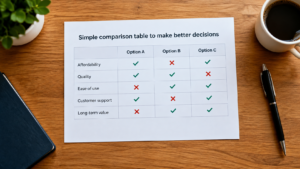
None of this is complicated. The hard part is actually doing it rather than just thinking about it.
1. Write Your Options Down
Get them out of your head and onto one page. Three is plenty. If you have ten, you probably need to narrow them down first.
2. Decide What Matters Most
Pick a few things you will judge each option on. Cost, time, how much you would enjoy it, how well it fits what you are already doing.
Some of those will matter more than others. Give them more weight.
3. Rule Out the Dealbreakers
Every decision has a few hard limits. A budget you can’t go over, or a deadline you can’t move.
Any option that breaks one of those is out, however good it looks otherwise.
4. Test Your Thinking
Ask yourself what would happen if one of your assumptions turned out to be wrong. Would you still choose the same option?
If a small change flips the answer, the choice is closer than you thought. That is useful to know.
5. Choose a Next Step
You don’t always need to make the whole decision today. Sometimes the right move is a small test, a deadline to decide by, or a conversation with someone who knows more than you.
What matters is that something moves. As I said in The Illusion of Progress being busy and getting somewhere are not the same thing.
What Is The No-Regret Decision System 2.0?
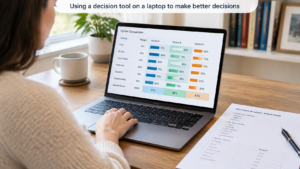
The No-Regret Decision System 2.0 is a digital kit that walks you through this kind of process, with the tools to do it properly.
The main part is the Decision Desk. It runs in your web browser on your own computer, without going online. You can compare three options against four weighted criteria, check them against your hard limits and run a simple stress test on the result.
It also keeps evidence notes, a next-step plan and a decision journal. When you are done, it can produce a printable memo, and you can save a backup of your work.
Alongside the desk you get:
– a 22-page guide with 20 short, practical lessons
– an 8-page fillable workbook
– 6 fictional worked examples showing the calculations
– 10 editable templates and a 2-page quick start guide
It costs $12 as a one-off payment, plus any sales tax. There is no subscription and no account to set up, and it comes with a 60-day money-back policy.
What It Isn’t
The seller is quite clear about this, which I appreciate.
It isn’t coaching, therapy or an AI that makes the decision for you. You put in your own information, and the scores help you think. They can’t promise a good outcome or take away all the uncertainty.
Despite the name, nothing can guarantee you won’t have any regrets. What it can do is help you show your working, so you know why you chose what you did.
A desktop or laptop is recommended too. Some phones won’t open the Decision Desk properly.
Who Might It Suit?
I think it suits anyone who keeps putting off everyday choices about projects, learning, work or planning, and who is happy to sit down and fill in their own details.
If you would rather someone told you what to do, it probably isn’t for you.
I haven’t used it myself yet. But for $12, a structured way to stop going round in circles seems like good value to me.
Want to Take a Look?
If you have a decision you keep putting off, this might be a sensible place to start.
Take a look at The No-Regret Decision System 2.0
There is no need to take my word for it. Have a look at what is included and decide whether it suits you.
Be the first to comment on "How to Make Better Decisions When You Keep Going Round in Circles"