
Plenty of people want to start an online business.
Far fewer actually get one off the ground.
It usually isn’t for lack of effort. More often, people get stuck right at the beginning. Which model should they choose? Which tools? What should they do first?
If you are wondering how to start an online business, the good news is that the barriers are much lower than they were a few years ago. You don’t need to write code. You don’t need a large budget. What you do need is a clear plan and the patience to follow it.
Disclosure: This post contains affiliate links. If you purchase through one of my links, I may receive a commission at no additional cost to you.
Why 2026 Is a Good Time to Start an Online Business
AI tools now handle jobs that once needed an agency or years of training. Building a website, writing a first draft, producing a graphic: all of these can be done in an afternoon.
People are also far more comfortable buying online than they used to be. Coaching, consulting, templates, courses. It is all bought and sold online every day.
Most website platforms are drag-and-drop now. Coding knowledge used to be essential. It isn’t any more.
Niche audiences work in your favour, too. People actively look for help with a specific problem, and a small business that focuses on that one problem can stand out against much bigger companies.
Then there is automation. Email sequences, social media scheduling and customer onboarding can all run in the background once they are set up properly.
None of that does the work for you, of course.
But it does mean the starting line is a lot closer than it used to be.
Step 1: Choose a Business Model That Fits Your Skills and Time
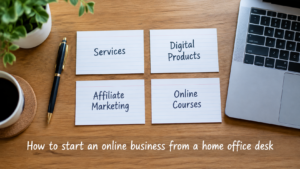
There are four common models for beginners.
Service-based businesses are usually the quickest route to income, because clients pay for a result straight away. Consulting, coaching and virtual assistance all fall into this group.
Digital products such as templates, planners or ebooks take longer to create at first, but once they are made they can be sold again and again.
Affiliate marketing removes product creation altogether. You recommend existing products through your own links and earn a commission when somebody buys. This is the route I chose myself.
Online courses turn what you know into something you can sell at scale, although they need the most preparation before launch.
So how do you choose?
A few simple questions help. How much can you afford to spend at the start? When do you need some income? How many hours a week can you realistically give it?
Many people start with one model and build towards another. A service can bring in money while a product or course is being created in the background.
Step 2: Build a Simple Foundation
Getting a website live is no longer the hurdle it once was.
A beginner-friendly platform, a domain name and a ready-made template are enough to get started. You can change the colours and images to suit you without hiring a designer.
If you are selling something directly, a payment processor such as Stripe connects to most platforms in under an hour.
One thing worth adding from day one is a way of collecting email addresses. A list of subscribers is something you own, and it becomes more valuable over time.
The key is to start simple rather than perfect. Five clear pages that explain what you offer and how people can buy are plenty to begin with.
If you would rather have someone walk you through this step by step, there are [digital marketing training programs] that cover exactly this kind of set-up, including which tools to use and how to configure them.
Step 3: Focus on the Marketing That Actually Brings Sales
Getting traffic matters far less than getting the right traffic.
It is tempting to try every platform at once. Facebook, Instagram, TikTok, YouTube, Pinterest. Before long you are spread so thin that nothing gets done properly.
A better approach is to pick two channels where your ideal customers already spend time, and learn those well.
Email is almost always worth being one of them.
A simple free offer (often called a lead magnet) gives people a reason to join your list. A short email sequence then gives them useful information before you introduce anything for sale.
I wrote about why this matters in [an earlier post](https://surelytheresabetterway.com/start-again-with-clickbank/). Somebody who clicks away from a sales page is usually gone for good. Somebody who joins your list can hear from you again.
Content doesn’t need to be a full-time job either. Create one useful piece each week, then reuse it. A single blog post can become several social media posts and a couple of email topics.
Step 4: Use AI Tools to Save Time
Once the basics are in place, AI tools can take a lot of the repetitive work off your hands.
Tools like ChatGPT or Claude can help you brainstorm ideas and produce first drafts of emails and marketing copy. Canva’s AI features can create graphics without any design background.
An email platform such as Kit (formerly ConvertKit) can send welcome sequences and follow-up emails automatically, so your list is looked after even when you aren’t working.
Simple chatbots can answer the same common questions you would otherwise answer again and again.
The trick is not to build a complicated collection of software. Choose a small number of tools that work well together. Many have free plans you can start on and upgrade later.
Your First 90 Days: A Simple Action Plan
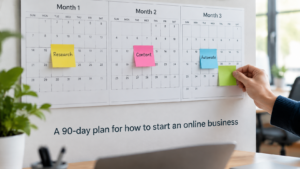
It helps to break the first three months into stages.
Month one: research and a first offer. Spend time where your ideal customers gather and make a note of the problems they mention. Then create one simple offer that solves one of those problems. The aim is your first customer, not a perfect product.
Month two: show up consistently. Set aside regular hours each week to share useful content where your audience already is. Facebook groups, Reddit, Instagram. Focus on being helpful rather than selling.
Month three: refine and automate. Look at what is working, improve your sales process and set up the automation that handles the repetitive tasks.
By the end of 90 days you should have a tested offer, a growing audience and the beginnings of a system that doesn’t rely on you doing everything by hand.
Where to Go From Here
Learning how to start an online business doesn’t require years of experience or technical knowledge.
It does require consistent action.
There is no guarantee of success, and anyone who promises you one should be treated with caution. But a clear plan, followed properly, gives you something you can build, test and improve.
That is a much better position than jumping from one idea to the next.
Want to Take a Look?
If you would like some structured help with any of the steps above, have a look at the [digital marketing training programs on Digital Class Masters]
There is no need to take my word for it. Look at what is on offer and decide whether it suits where you are right now.
Disclosure: Digital Class Master contains affiliate links. If you buy something through one of those links, I may receive a commission at no additional cost to you.
Be the first to comment on "How to Start an Online Business in 2026: A Simple Roadmap for Beginners"